
For the GCSE English Language exams, you are required to read challenging unseen texts (extracts that you may have never seen before). To confidently answer questions, one must become confident in reading and understanding unseen texts.
Based on my teaching experiences, I have observed that many students struggle with understanding the given unseen texts. Reading and comprehension skills develop over time and with consistency.
The First Step
Read, read and read some more! Read a wide range of texts.
Reading widely is important for several reasons:
- Broadened Perspective: When you read widely, you expose yourself to a diverse range of ideas, perspectives, cultures, and experiences. This broadens your understanding of the world and helps you develop empathy and appreciation for different viewpoints.
- Intellectual Growth: Reading widely challenges your thinking and expands your knowledge base. It exposes you to new concepts, theories, and information across various subjects, fostering intellectual growth and curiosity.
- Enhanced Creativity: Exposing yourself to a wide range of literature, genres, and topics stimulates your imagination and creativity. It allows you to draw connections between seemingly unrelated ideas and inspires innovative thinking.
- Improved Communication Skills: Reading widely exposes you to different writing styles, vocabulary, and forms of expression. This can improve your own writing and communication skills, as you learn from the techniques and strategies employed by various authors.
- Cognitive Benefits: Engaging with diverse content through reading has been linked to cognitive benefits such as improved memory, critical thinking skills, and problem-solving abilities. It keeps your mind active and engaged, which is important for mental agility and overall cognitive health.
- Empowerment: Reading widely empowers you with knowledge and information. It enables you to make informed decisions, participate in discussions, and navigate the complexities of life with confidence.
Active Reading
To become more confident with understanding unseen texts, there are some basic questions you must keep in mind:
- Who: Asking “who” helps identify the characters or individuals involved in the text. Understanding the characters’ roles, motivations, and relationships can provide insights into the plot, themes, and conflicts of the text.
- What: “What” questions focus on the events, actions, or concepts described in the text. They help readers identify important plot points, central ideas, and key themes.
- Where: “Where” questions help establish the setting or location of the text. Understanding the physical environment in which the story takes place can enhance readers’ comprehension and visualization of the narrative.
- When: Asking “when” helps establish the timeline or sequence of events in the text. Understanding the temporal context of the story can provide insights into character development, plot structure, and thematic elements.
- Why: “Why” questions delve into the motivations, reasons, or causes behind the events or actions described in the text. They encourage readers to analyze characters’ decisions, authorial choices, and thematic elements, leading to deeper understanding and interpretation.
Unseen texts example
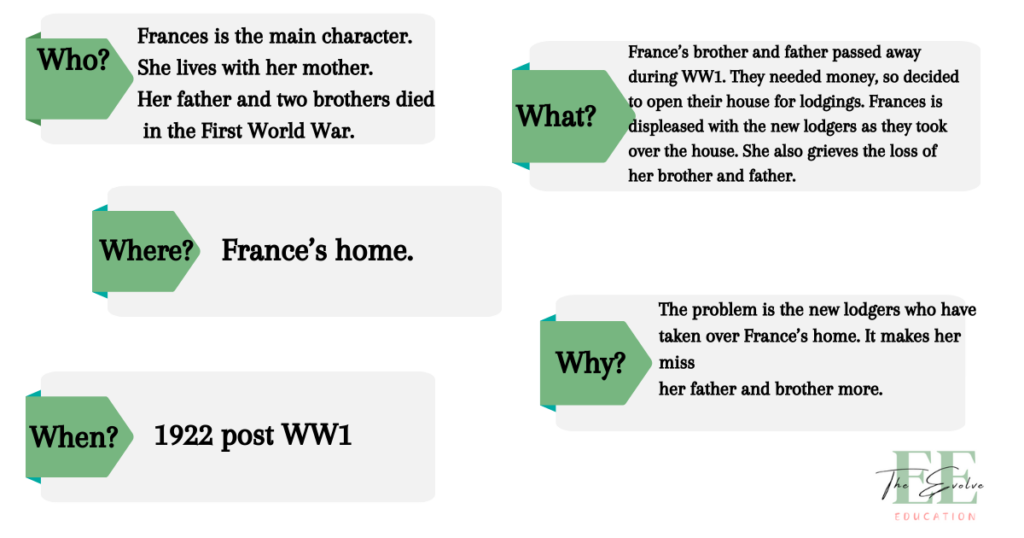
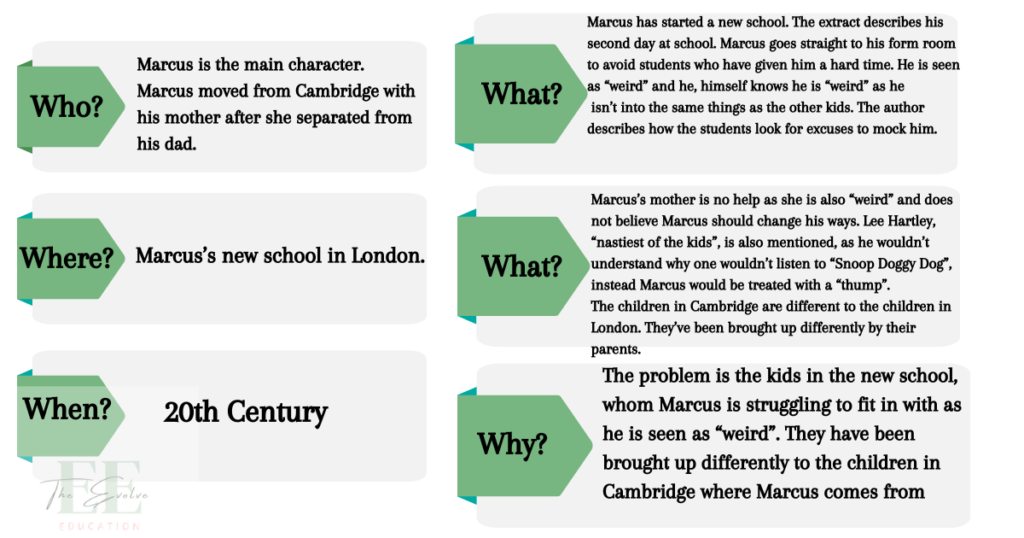
I’ve included two fictional extracts with the 5’s answered as an example.
The Paying Guests– Sarah Waters (prose fiction, 2014)
London, 1922. Frances’s father and her two brothers, Noel and John Arthur, have been killed during the First World War. Frances and her mother have decided to take in lodgers as they are short of money. The lodgers, Mr and Mrs Barber, have just arrived at their house and are currently unpacking upstairs.
As Frances reached to the lamp there were more footsteps in the room above; and then her hazel eyes returned to the ceiling.
‘It might be Noel or John Arthur up there,’ she murmured, as the light went down.
And, yes, thought Frances a moment later, lingering in the shadowy hall, it might be; for she could smell tobacco smoke now, and hear some sort of masculine muttering up on the landing, along with the tap of a slippered male foot… And just like that, like a knee or an elbow receiving a blow on the wrong spot, her heart was jangling. How grief could catch one out, still! She had to stand at the foot of the stairs while the fit of sorrow ran through her. But if only, she thought, as she began to climb — she hadn’t thought it in ages — if only, if only she might turn the stair and find one of her brothers at the top — John Arthur, say, looking lean, looking bookish, looking like a whimsical monk in his brown Jaeger dressing- gown and Garden City sandals.
There was no one save Mr Barber, a cigarette in the corner of his mouth, his jacket off, his cuffs rolled back; he was fiddling with a nasty thing he had evidently just hung on the landing wall, a combination barometer-and-clothes-brush set with a lurid orangey varnish. But lurid touches were everywhere, she saw with dismay. It was as if a giant mouth had sucked a bag of boiled sweets and then given the house a lick. The faded carpet in her mother’s old bedroom was lost beneath pseudo-Persian rugs. The lovely pier-glass had been draped slant-wise with a fringed Indian shawl. A print on one of the walls appeared to be a Classical nude in the Lord Leighton manner. The wicker birdcage twirled slowly on a ribbon from a hook that had been screwed into the ceiling; inside it was a silk-and-feather parrot on a papier-mâché perch.
The landing light was turned up high, hissing away as if furious. Frances wondered if the couple had remembered that she and her mother were paying for that. Catching Mr Barber’s eye, she said, in a voice to match the dreadful brightness all around them, ‘Got everything straight, have you?’
whimsical: unusual, playful and unpredictable
barometer: an instrument used to forecast the weather
Waters. S, The Paying Guests, (2014), Virago Press, London, pp.16-18.
About a Boy– Nick Hornby (prose fiction, 1998)
12-year-old Marcus’s mother and father separated four years ago. Marcus has recently moved from Cambridge to London with his mother. It is his second day at his new school and he has arrived early and gone to the form room to try and avoid some students that have been giving him a hard time.
There were a couple of girls in the room, but they ignored him, unless the snort of laughter he heard while he was getting his reading book out had anything to do with him.
What was there to laugh at? Not much, really, unless you were the kind of person who was on permanent lookout for something to laugh at. Unfortunately, that was exactly the kind of person most kids were, in his experience. They patrolled up and down school corridors like sharks, except that what they were on the lookout for wasn’t flesh but the wrong trousers, or the wrong haircut, or the wrong shoes, any or all of which sent them wild with excitement. As he was usually wearing the wrong shoes or the wrong trousers, and his haircut was wrong all the time, every day of the week, he didn’t have to do very much to send them all demented.
Marcus knew he was weird, and he knew that part of the reason he was weird was because his mum was weird. She just didn’t get this, any of it. She was always telling him that only shallow people made judgements on the basis of clothes or hair; she didn’t want him to watch rubbish television, or listen to rubbish music, or play rubbish computer games (she thought they were all rubbish), which meant that if he wanted to do anything that any of the other kids spent their time doing he had to argue with her for hours.
He usually lost, and she was so good at arguing that he felt good about losing. She could explain why listening to Joni Mitchell and Bob Marley (who happened to be her two favourite singers) was much better for him than listening to Snoop Doggy Dogg, and why it was more important to read books than to play on the Gameboy his dad had given him. But he couldn’t pass any of this on to the kids at school.
If he tried to tell Lee Hartley – the biggest and loudest and nastiest of the kids he’d met yesterday – that he didn’t approve of Snoop Doggy Dogg because Snoop Doggy Dogg had a bad attitude to women, Lee Hartley would thump him, or call him something that he didn’t want to be called. It wasn’t so bad in Cambridge, because there were loads of kids who weren’t right for school, and loads of mums who had made them that way, but in London it was different.
Hornby. N, About a Boy, (1998; this edition: 2014), Penguin Books, London, pp.13-14.
Click on the links below to access fictional extracts. Read the extracts and answer the 5 W’s.
https://filestore.aqa.org.uk/resources/english/AQA-87001-RSB.PDF
https://www.ocr.org.uk/Images/373395-unseen-20th-and-21st-century-literary-texts.pdf
Please find a booklet containing fictional extracts that are suitable for KS3 students.
Non-Fiction
In addition, there are slightly different questions to focus on when engaging with unseen non-fictional extracts.
- What is the text about?
- Who wrote the text?
- How do they feel about the topic that is being discussed?
- What is the purpose of the text?
- Who is the audience?
- What is the tone/register of the text?
- Does the tone change?
- What is the form (article, letter, diary, speech, essay) of the text?
Get access to non-fictional extracts and improve your reading skills by answering questions for each source. Check out the booklet and link now.
http://www.thebourneacademy.com/_site/data/files/documents/2018/DFB9403914EBD1F85422AD937CFE173B.pdf
As readers read a text, they can actively engage and deepen their understanding by asking various questions and extracting key information. This practice not only enhances the overall reading experience but also promotes critical thinking and analytical skills. Additionally, asking questions can help readers identify and comprehend the content’s themes and messages.
In conclusion, remember active reading is key! To move up the learning ladder and be able to analyse, infer and evaluate, you must ensure that the basic reading and comprehension skills are strengthened.
Check out How to get a Grade 9 in GCSE English. There, you will find some tips on how to become more confident with understanding unseen Texts.


Leave a comment. We would love to hear your thoughts!